History
Why Porto has fado too
Fado was born in Lisbon and has its own tradition in Coimbra, so why hear it in Porto? The history, the instrument and the city, in brief and sourced.
Choose your night on the Cais ↗Quick answer
Fado began in Lisbon, and Coimbra's students made their own version of it, yet the music travelled the length of the country long ago. Porto's merchants were playing citterns, ancestors of the Portuguese guitar, at home in the eighteenth century, and in the 1930s professional fado companies toured theatres north and south. Today fado is a symbol of Portuguese identity, inscribed by UNESCO in 2011, and Porto musicians perform it in their own city.
Lisbon first
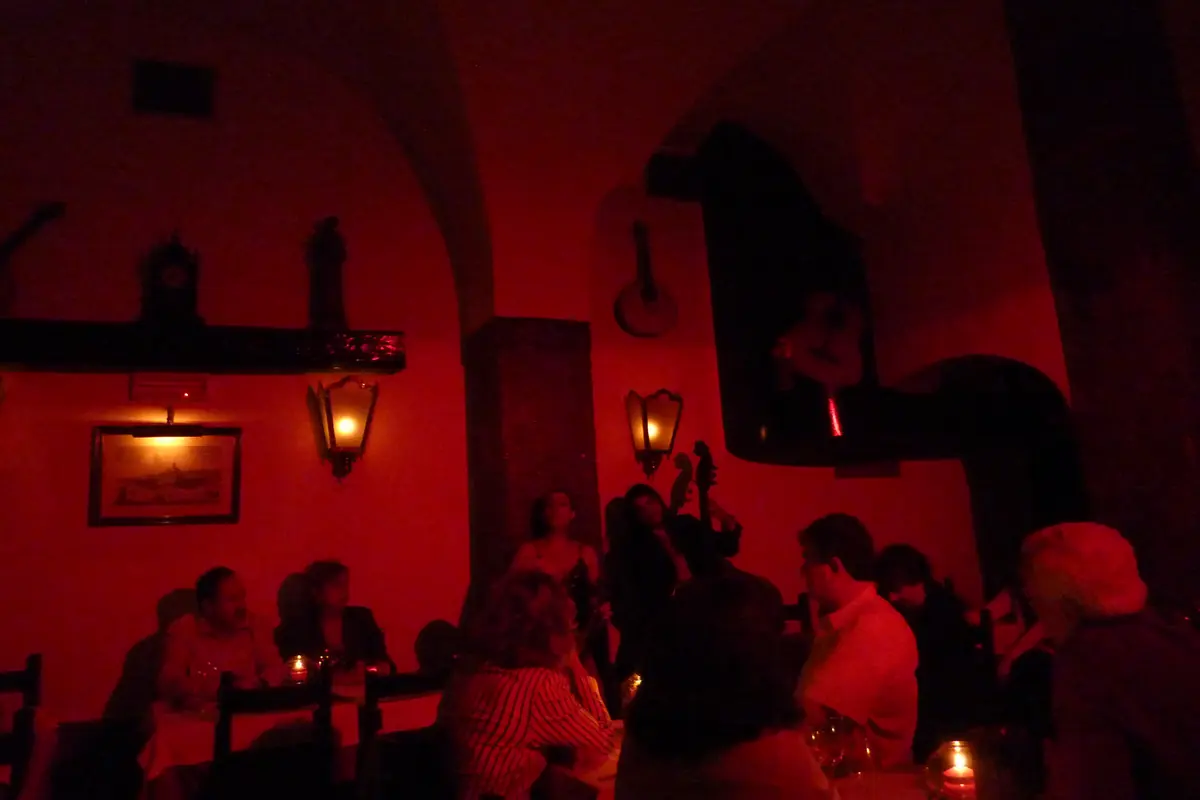
According to Wikipedia, fado can be followed back to Lisbon in the 1820s, to the bohemian streets of Alfama, Mouraria and Bairro Alto, and it probably has older roots still. The Fado Museum describes its first settings as taverns, streets, gardens and bullfights, among sailors, coachmen and people on the margins of the city, and it notes that intellectuals long rejected it for those associations. Theatre carried it to a wider public: fado appeared in Lisbon's revue theatre from 1870, and by the twentieth century records and radio were spreading it further.
Coimbra's separate tradition
Coimbra, the university city, grew a style of its own, linked to the students and to the old practice of serenading. Wikipedia describes it as sung exclusively by men, at night, in squares and streets, with singers and musicians in the academic dress of dark robe and cape. Its guitar evolved into a different instrument, tuned lower and with a darker tone. When people say fado has two great schools, these are the two cities they mean, which is why a Porto concert can feel like a visit to neither and both.
Porto and the guitar
Porto's link with the instrument is older than many visitors expect. Wikipedia's history of the Portuguese guitar describes how a new cittern, the so-called English guitar, appeared in Portugal around 1750, and how a locally modified cittern was taken up enthusiastically by the new merchant class of Porto, who played it at home. The English guitar disappeared as a separate instrument in the nineteenth century, but its watch-key tuning system, its size and its tuning shaped the Portuguese guitar that fado players use today.
Touring the country
According to the Fado Museum, the 1930s brought professional fado companies whose large casts toured theatres north and south of the country, and even abroad. Records and radio helped too: the museum notes that Portugal's first radio station, which began broadcasting in 1925, included fado in its programmes and reached listeners in the emigrant diaspora.
A symbol of Portugal
UNESCO added fado to its intangible heritage roll in 2011. The inscription credits emigrants and the world-music stage with turning fado into a byword for being Portuguese. That is the setting for a concert in Porto: musicians from the city performing the country's best-known song form, by the river whose trade built the city, for listeners from all over the world.
What that means for your evening
You are not hearing a Lisbon import staged for visitors, nor a copy of the Coimbra serenade. You are hearing the shared national form, played by Porto musicians in the Lisbon-style line-up of voice, Portuguese guitar and viola. The venue on the Cais de Gaia is a project by two Porto musicians, supported by the community where they live and work, with the aim of sharing traditional fado with visitors and locals alike. That is as good a reason as any for fado to sound at home by the Douro.
Frequently asked questions
Is fado from Porto?
No. Fado began in Lisbon, with a separate tradition in Coimbra. It is now performed across Portugal, including by Porto musicians in their own city.
When did UNESCO recognise fado?
UNESCO inscribed fado on its intangible cultural heritage list in 2011; Wikipedia gives the date as 27 November 2011.
Is the Porto concert in the Coimbra style?
It follows the Lisbon pattern of a singer with Portuguese and classical guitars. The Coimbra serenade is a different practice, kept by male singers in student capes.
Sources